


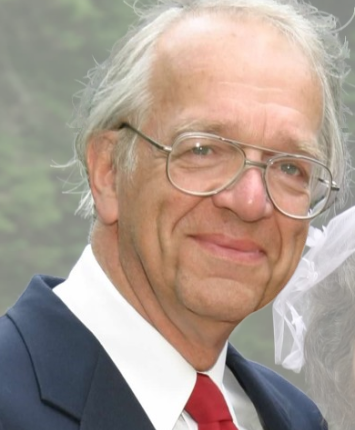
In Memory Of

Service Information
Private
The family asks that you please make a donation in Bill's name to Garden City Historical Society.

William A. Bellmer: The Engineer Who Preserved a Village’s Memory
William A. Bellmer spent a lifetime trying to answer one deceptively simple question:
How does it work?
As a child, that question led him to remove doorknobs, disassemble household appliances, and investigate anything mechanical or electrical that crossed his path. As an engineer, it led him into some of the most advanced military electronics programs of the Cold War. And in retirement, it transformed him into the foremost authority on the history of Garden City, New York, where he lived for 86 years, and spent more than a decade documenting the people, buildings, decisions, and events that shaped the community he loved.
Bill Bellmer died peacefully at home on June 10, 2026 at the age of 90, leaving behind a remarkable legacy as an engineer, inventor, builder, historian, husband, father, grandfather, and lifelong student of how things—and people—come to be.
Born in 1936 in Brooklyn, Bill became a Garden City resident in 1940 and remained deeply connected to the village for the rest of his life. Long before he became known as Garden City Village Historian, however, he was part of a generation of engineers helping to create the technologies that defined the modern world.
After earning a Master of Electrical Engineering degree from the Polytechnic Institute of Brooklyn’s renowned Microwave Research Institute, Bill began a career that would span more than four decades. At a time when digital electronics was still in its infancy, he worked on sophisticated military and aerospace systems requiring a rare combination of mathematical rigor, creativity, and practical engineering skill.
At Sperry Gyroscope, he worked in logic design and spent time in Germany helping develop systems intended to detect nuclear explosions. He later joined Reeves Instrument, where he worked on the military’s BOTH project—Bombing Over The Horizon—designing the digital logic systems that connected radar inputs, computers, and operator displays. Subsequent positions at Potter Instrument, Miltope Corporation, and Phoenix Group continued his involvement in advanced military electronics, ruggedized computing systems, and technologies designed to function in some of the world’s harshest environments.
Yet those who knew Bill best understood that his most interesting inventions were often the ones he created simply because he wanted to.
Years before intermittent windshield wipers became commonplace, Bill designed his own controller in 1959. In 1960, he built a telephone answering machine for personal use. Decades later, he was still inventing: creating systems that displayed shower-water temperature at the showerhead, transforming an antique Hong Kong gong into a doorbell, and devising countless practical improvements around his home.
The remarkable thing was that he did not care about commercial success.
He built things because building them was fun.
Friends and neighbors came to know him as the person who could fix almost anything. Even as a teenager and young man, he helped his neighbors by installing sprinkler systems, repairing plumbing and electrical problems, rebuilding machinery, and tackling projects that most homeowners would never attempt, especially without the help of YouTube. He helped his father rebuild their family home on Sackville Road, including replacing the roof more than once. At his own home on Poplar Street, he personally constructed major additions, including a kitchen expansion, new bathrooms, and an exterior entrance to the basement, which he thought every house should have.
To Bill, every project was an opportunity to learn.
That same mindset eventually led him into a second career that may prove every bit as enduring as his first.
In 2015, Bill became Garden City’s Village Historian. He inherited file cabinets filled with photographs, documents, maps, reports, and records accumulated over generations. Most people would have seen an archive.
Bill saw a system waiting to be organized.
Over the following years, he undertook an ambitious effort to digitize and classify thousands of historical records. He developed identification methods, organizational systems, and digital collections that transformed scattered materials into a searchable historical resource available to residents, researchers, authors, and future historians.
His philosophy was simple: every item mattered.
Every photograph should be identified.
Every document should be cataloged.
Every artifact should have a story.
“There should be no entries not identified,” he often said.
Under his leadership, Garden City’s historical collections expanded dramatically through digital archiving efforts and contributions to New York Heritage. He organized thousands of records into four major collections on the NYHeritage.org website, including Village Archives, Garden City Books and Articles, the General Collection of resident-submitted materials, and the extensive Vincent F. Seyfried Postcard collection.
His work reflected a belief that history was not merely about preserving old things. It was about understanding cause and effect.
Why was a building located where it was?
Why did a decision succeed or fail?
How did today’s village become the community residents experience now?
“Somebody has to write the book,” he would often say.
Bill believed history provided the written path explaining how a community arrived at the present. Historical markers, archives, photographs, annual reports, and forgotten records connected one generation to the next. Without them, communities lost part of their identity.
His historical research helped countless residents, authors, and researchers. He worked closely with longtime friend and noted historian Vincent F. Seyfried and assisted numerous others seeking to understand Garden City’s past. He enjoyed working with authors including Howard Kroplick and Al Velocci (The Long Island Motor Parkway) and Constantine and Emmanuel Theodosiou (Garden City: The First 150 Years), who benefited from his knowledge, archival resources, and willingness to help others tell the village’s story accurately.
Residents came to regard him as the authority on Garden City history. If there was a question about a building, a neighborhood, a village decision, a photograph, or a long-forgotten event, the answer often began with Bill.
Yet he never viewed himself as the story.
He viewed himself as the caretaker of the evidence.
In many ways, the engineer and the historian were the same person. Both required patience, precision, curiosity, and respect for facts. Both demanded the ability to follow evidence wherever it led. Both sought to understand how individual pieces fit into a larger system.
Bill spent his life building things—electronic systems, home improvements, inventions, archives, collections, and knowledge itself.
What he ultimately built for Garden City was something even more lasting: a memory.
William A. Bellmer is survived by his wife of more than sixty years, Mathilde Bellmer, whom he married in 1964; his daughter, Angelique Bellmer Krembs, GCHS Class of 1986; his grandchildren, Sophia Victoria Krembs and George Anton Krembs; and countless friends, neighbors, researchers, and residents whose understanding of Garden City’s history was enriched by his work.
He was preceded in death by his beloved daughter, Adrienne Bellmer.
For a man who spent his life asking how things worked, perhaps his greatest achievement was helping others understand where they came from.
If you are inclined to make a donation in Bill Bellmer’s name, please consider the Garden City Historical Society.
A Funeral Mass for Bill Bellmer will be held at St Joseph’s Church, 130 Fifth Street, Garden City NY, on Saturday, June 20 at 9:30am. You can imagine that he really didn’t want a fuss about this, so we are keeping it simple.
At a later date (and probably over his objections) we plan to organize a tribute to Bill Bellmer’s life and work, and if you are interested to attend, you can email angeliquebellmer@gmail.com to be notified of the details.
Guest Book


